| 1 | Enclosed UVC Air-Disinfection Unit | Occupied rooms, classrooms, clinics, offices, and waiting areas | Low-pressure mercury or amalgam UVC lamps, commonly centered near 253.7 nm | 2–8 mW/cm² inside the shielded chamber; effective room dose depends on airflow and residence time | 9,000–12,000 hours | High when the housing is interlocked, fully enclosed, and leak-tested | Approximately 250–1,200 m³/h per unit | 80–350 W | US$3,000–10,000 | 89/100 | Strong balance of safety, continuous operation, predictable maintenance, and moderate installed cost |
| 2 | In-Duct UVC HVAC System | Air treatment inside supply ducts, return ducts, coils, and air-handling units | High-output low-pressure or amalgam UVC lamps | 1,000–3,000 µW/cm² at the treated coil or target surface; engineering verification is required | 9,000–16,000 hours | High when installed inside sealed ductwork with access-door interlocks | Approximately 2,000–50,000 m³/h, depending on air-handler size | 150–1,500 W | US$7,000–20,000 | 87/100 | Efficient for centralized buildings and useful for coil surface control and continuous air treatment |
| 3 | Upper-Room UVGI System | Large occupied spaces with high ceilings and continuous airborne infection-control needs | Shielded low-pressure UVC fixtures, usually near 253.7 nm | Typically 150–400 µW/cm² in the upper-room treatment zone; lower levels must remain below exposure limits | 8,000–12,000 hours | Medium to high when professionally designed, measured, and commissioned | Approximately 50–150 m² per fixture, subject to ceiling height and ventilation | 30–150 W per fixture | US$4,500–12,000 | 84/100 | Low energy use and good scalability for high-occupancy rooms when exposure control is carefully managed |
| 4 | Point-of-Use UVC Water Reactor | Drinking water, process water, wastewater polishing, and microbial reduction in clear liquids | Low-pressure mercury, amalgam, or UVC LED reactor modules | Typical validated UV dose: 30–60 mJ/cm²; actual dose depends on flow, UV transmittance, and lamp output | 9,000–16,000 hours for lamps; UVC LEDs commonly use an output-maintenance rating | High because UVC is contained within the reactor body | Approximately 1–100 m³/h for common commercial systems | 40–1,200 W | US$4,000–18,000 | 82/100 | Highly measurable treatment performance when flow rate, UV transmittance, and delivered dose are monitored |
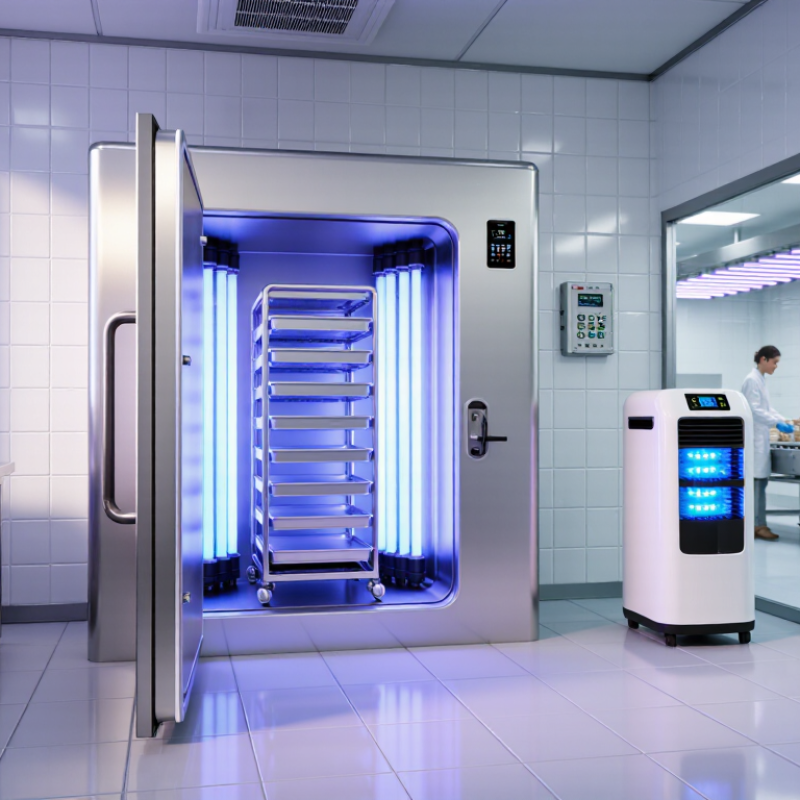
| 5 | UVC Sterilization Cabinet or Chamber | Small tools, laboratory items, personal equipment, packaging, and exposed surfaces | Low-pressure UVC lamps or UVC LED arrays | 2–10 mW/cm² at exposed surfaces; shadowing and surface distance strongly affect delivered dose | 9,000–20,000 hours, depending on source type | High when equipped with door interlocks, opaque walls, and automatic cycle controls | Approximately 0.05–2 m³ chamber volume | 40–500 W | US$4,000–18,000 | 79/100 | Compact, repeatable, and comparatively easy to validate for small loads with clear line-of-sight exposure |
| 6 | Autonomous UVC Surface-Disinfection Robot | Unoccupied patient rooms, operating areas, laboratories, transport vehicles, and high-touch surfaces | Multiple low-pressure UVC lamps or high-power UVC LED modules | Approximately 1–3 mW/cm² at 1 m for many systems; delivered dose depends on distance, dwell time, and shadowing | 6,000–12,000 hours | High only when motion sensors, occupancy detection, emergency stop, and access controls are functional | Approximately 20–100 m² per automated cycle | 300–1,500 W during active treatment | US$25,000–80,000 | 75/100 | Automates large-area surface cycles and records treatment history, but has the highest capital and validation cost |